
The story of Van Gogh’s Sunflowers
Few paintings in art history are as instantly recognisable as Vincent van Gogh’s Sunflowers series. With their radiant yellows, swirling brushstrokes and emotional intensity, these works have become synonymous with the artist’s passion, pain and pursuit of beauty in the everyday. But beneath their golden glow lies a deeper story.
The symbolism of Sunflowers
Vincent van Gogh was a Dutch Post-Impressionist painter who spent much of his life living in poverty and struggling with his mental health.
Creating over 2,000 artworks in just over a decade, he painted arguably his most famous collection, Sunflowers, in two distinct phases. The first, created in Paris in 1887, was a series of exploratory works that experimented with still life and colour, and depicted cut sunflowers lying flat on the ground. But it was in Arles, in the south of France, during 1888-89, that Van Gogh produced the more widely celebrated series – seven paintings of sunflowers in a vase – each with subtle variations in composition, colour and texture.
“Many artists do this,” says John Myatt, the former master art forger who has recreated the iconic series. “I think Van Gogh recreated some of the paintings he’d already done because he liked them so much. He felt that he needed more of them in his life.”
Van Gogh created the paintings to decorate the guest room of his ‘yellow house’, which he prepared for Paul Gauguin, whom Van Gogh hoped would help establish a new artistic community in Arles, the ‘Studio of the South.’
But Van Gogh saw Sunflowers as much more than decorative floral studies. In his letters, particularly to his brother Theo, he made it clear that these deeply personal works represented light and friendship, describing them as ‘symbolic of gratitude’. He saw them as a metaphor for the human condition – vibrant and hopeful, but fleeting.
“I think Van Gogh identified with Sunflowers,” Myatt reflects. “There was a feeling of vitality, a feeling of transience, really, because while many of the sunflowers in the pictures are dying, some are coming to life.”
Inside a master’s mind
This duality of life and death, bloom and decay, is central to the series. Beneath the joyful yellows is an unsettling edge, as Van Gogh sought to elevate still life beyond technical demonstration. His goal was to express inner emotion through colour and movement, breaking from realism and classical composition in favour of psychological impact.
“Some people have pointed out that the sharp, angular, pointed leaves are quite cruel shapes, they’re quite aggressive shapes,” Myatt observes. “There is an undercurrent to all of the paintings, as well as happiness, there is a sense of something slightly sinister underneath.”
After Van Gogh’s death in 1890, his brother Theo – who had supported him emotionally and financially – died just months later. Theo’s widow, Johanna van Gogh-Bonger, inherited the artist’s collection and played a pivotal role in promoting his work. She organised exhibitions, sold key pieces to influential collectors and ensured Van Gogh’s legacy endured. The Sunflowers series quickly became emblematic of his genius, as it was recognised as a pure representation of the bold experimentation, emotion and symbolic depth that defined his artistic vision.
Over time, the paintings were acquired by major institutions across the world, including Amsterdam, Munich and Philadelphia.

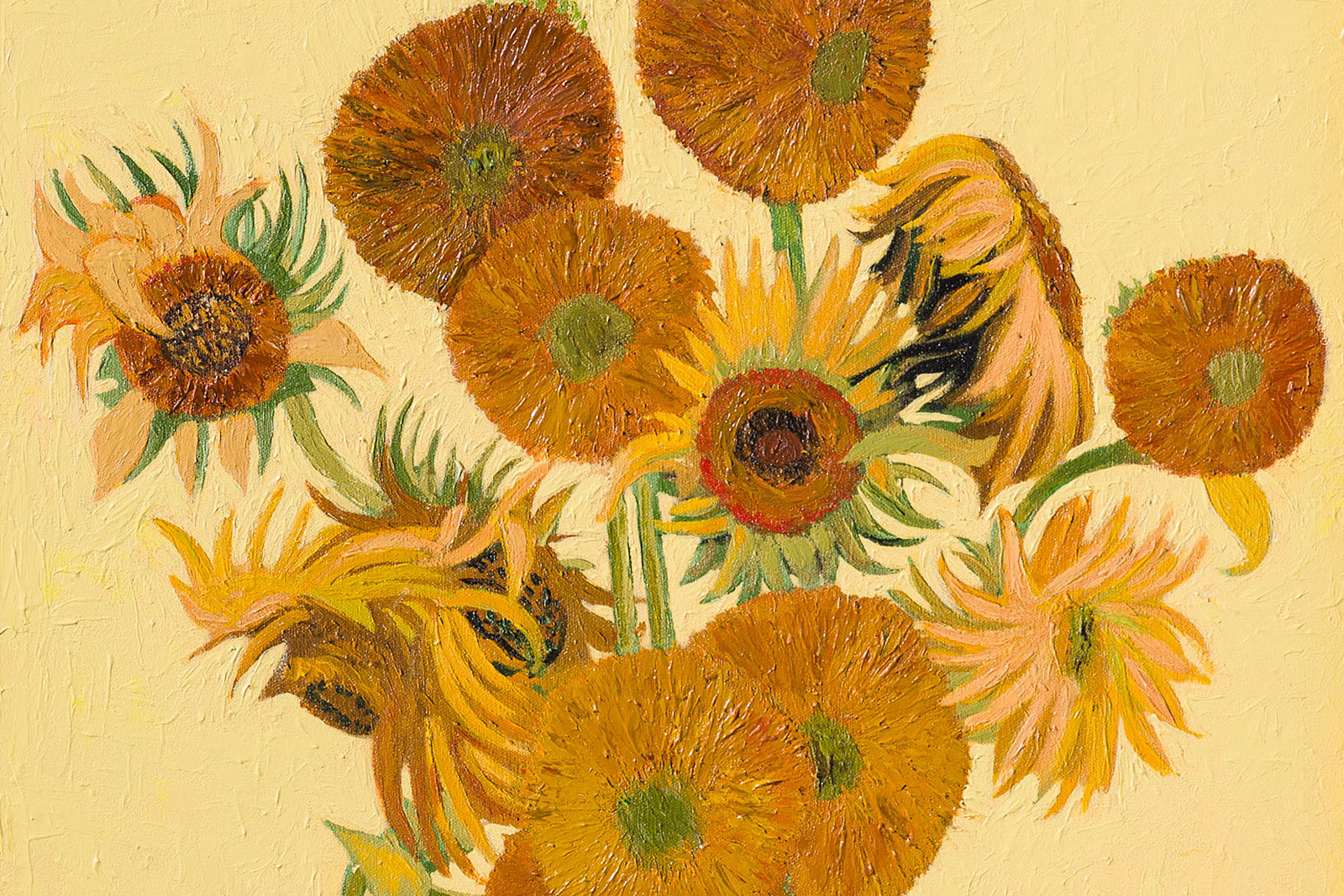
Featured Art: 'Sunflowers in the Style of Vincent Van Gogh, 1888-9 | Tokyo' by John Myatt.
Notable works
With its vibrant composition and balanced structure, among the most recognisable versions of Sunflowers is the piece housed in the National Gallery in London.
“When many people think of Van Gogh’s Sunflowers, the London edition is the one they have in their mind’s eye,” Myatt notes. “It is in some ways the most complete, but the colours that Van Gogh used have faded over time – green becomes grey, yellows become pale, and so we can’t be 100% sure that we’re looking at the painting that left the easel when he finished it.”
Another version in the series, ‘Six Sunflowers’, is often referred to as the ‘lost’ Sunflowers painting. It was bought by a Japanese collector in 1920, but was tragically lost in a fire as a result of a World War II bombing. Art historians suggest this version explored a cooler emotional tone, perhaps reflecting Van Gogh’s variable mental state at the time.
“It’s a really interesting example of the Sunflowers series because it’s got this dark blue background, which the others don’t,” Myatt explains. “And it’s just a joy to think that I am in a position to bring something back to life again.”

Featured Art: 'Sunflowers in the Style of Vincent Van Gogh, 1888-9 | Philadelphia' by John Myatt.
Each of Van Gogh’s Sunflowers tells its own story, and together they form a portrait of an artist who poured his soul into every detail. In the context of Van Gogh’s life, particularly his isolation and emotional turbulence, these paintings take on a deep personal significance, reflecting both the light he sought and the darkness he battled.
Through the eyes of John Myatt, we glimpse both the brilliance and fragility of a true master.